
The Tick

I suppose if you are a comic-book villain working to have your monolithic evil empire take over the world, you have to get to video streaming services sooner or later. Since 2006 Amazon had been experimenting with various video streaming services, but it wasn't until 2015 that the Amazon Prime Video brand we all know and… well, know, was established. In its attempts to take on the streaming Goliath of Netflix, the plucky little underdog Amazon looked sought to distinguish itself through unique, quirky original content. Clearly, the stress of figuring out what exactly this new, quirky original content should be was too much for the young Amazon Prime Video executives and so, rather than let the challenges of content programming interfere with their golf sessions, seal-clubbing expeditions, or whatever it was they would rather have been doing, they decided to let the viewers be the ones who choose which shows to make.
This lazy and cowardly abdication of responsibility came in the form of “Pilot Season”, in which a range of pilot episodes for potential future shows were tethered to a stake in a forest, while television executives waited behind a bush to see if they tempted any unsuspecting wild audiences away from the fertile feeding grounds of other streaming services.
In 2016, these TV-wannabe shows included such inexplicable gems as:
- I Love Dick, an “experimental” comedy-drama;
- the even less explicable Jean-Claude Van Johnson, a baffling action-comedy starring Jean-Claude Van Damme;
- One Mississippi, which I did not see but which apparently did quite well.
And then there was the most baffling big blue surprise of them all: The Tick.
An origin story for an originless character
The Tick was created in 1986 by the then high-school student Ben Edlund. It started out as a mascot for a newsletter published by New England Comics, back when newsletters were made of paper and contained news about things people cared about, as opposed to the modern variants that arrive via email directly into your spam folder and contain increasingly desperate appeals for attention from failing brands. I am not sure why a newsletter needed a mascot, it feels a bit like a paperclip having a theme tune, but clearly this one did; and it was suprisingly popular.
The Tick was an early and influential example of the emerging superhero-satire genre, a forerunner of Deadpool and The Boys; and won over its fans through irreverent and absurd humour. The Tick himself is a gloriously over-the-top hero, brimming with boundless optimism and a poetic sense of justice that elevates even the most absurd situations into noble crusades. Like a modern-day Don Quixote, The Tick’s grip on reality is questionable, but it leaves him with an almost admirably clear and unflinching belief in heroic ideals. Unlike Cervantes’ knight, whose idealism often carries a note of poignancy, and even quiet tragedy, The Tick remains buoyant, irrepressible, and joyfully absurd, guided not by logic but by an earnest, childlike certainty that good must prevail. Despite being a clear parody of the black-and-white moral justice of many superhero comics, the simplicity brings undeniable charm to The Tick, rendering him at once comically naïve and profoundly sincere, a reminder that courage and kindness need not be complicated to be real.
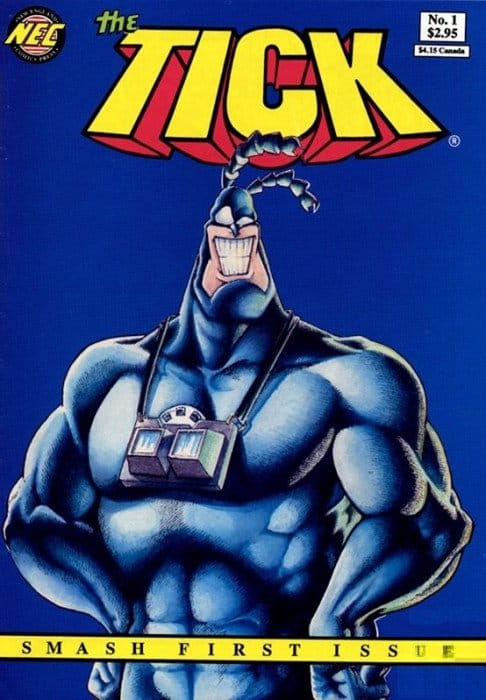
Such was its popularity that, in 1988, New England Comics published The Tick #1, written and drawn by Edlund. Comic books in 1988 were still somewhat niche, and, existing as it did as a parody of other comic books, The Tick was perhaps unsurprisingly not an instant mainstream success. However, it managed to build a small but loyal audience, and, through the early 1990s, reprints and wider distribution steadily increased its exposure. The Tick started to get recognised within the wider US comic fandom, which was no doubt when it caught the eye of another altogether different animal.
The Tick on the Fox
Fox has long held a reputation for finding amazing, innovative, and bold new programming, and then cancelling it because it was in a bad mood one day and the show sort of blanked Fox at the coffee machine. I mean, Fox was not sure that it did blank it; it was walking up to the machine, but was still kind of far away, and the show was kind of distracted, looking at its phone or something, but Fox was pretty sure that it should have seen it, so it felt pretty blanked. And anyway, it did not care about the stupid show because it had new, more exciting shows to hang out with; and yes, Fox had skipped breakfast that morning, and yes, it was trying a new all-cucumber cleanse, and maybe low blood sugar was a factor, but whatever, it could just show more episodes of The Simpsons or whatever.
This reputation notwithstanding, the idea that Fox wanted to pick up The Tick and turn it into a mainstream show for its Fox Kids network was no doubt huge for Edlund. In later interviews, he described the experience as both unexpected and surreal.
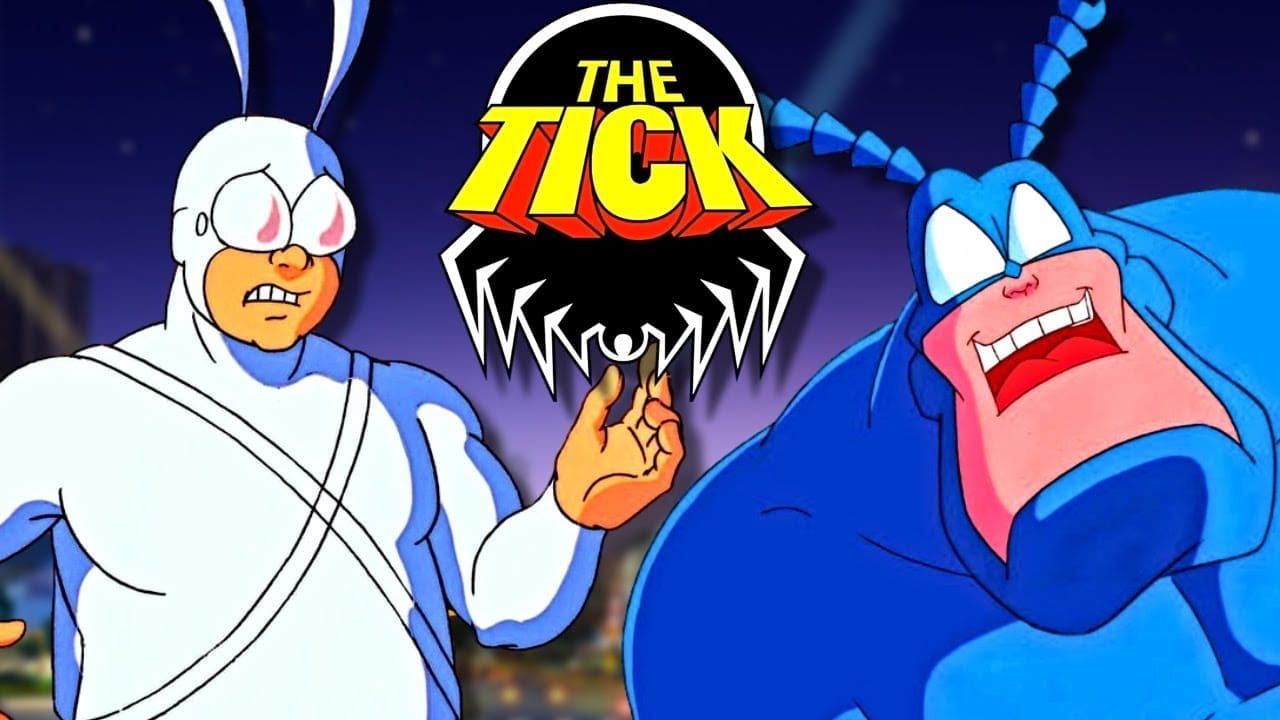
Despite the inevitable toning down of the original comic’s darker and more absurdist elements, this animated incarnation of The Tick preserved the core humour and expanded the world-building. With the new format, The Tick reached an entirely new audience; it was also the version of the show that first came to the attention of a certain sexually charismatic and humble writer of this very article. I would like to pretend that I had read the comic first, and held a regular subscription to the original newsletter, but sadly, like so many growing up in Nottinghamshire, England, I was deprived of the opportunity to have my finger truly on the pulse of the New England comic scene. To this day, I still have no idea what's really going on in Vermont.
The show was critically praised, developed a loyal fanbase, and performed well in the ratings; and so Fox was left with no choice but to cancel it in the third season. The problem was that The Tick was never really a children’s show: the ironic, satirical, and absurd nature of the show appealed to an older, more jaded audience, but not to the core audience that Fox Kids was aiming for.
Reading from a leaked memo taken from a Fox shareholder meeting, the target demographic for Fox Kids was described by a board member as follows:
“The children… such exquisitely weak and malleable minds into which our programming may seep, and corrupt their hearts. The eager pawns that become an army of drones compelling the hapless parents to lavish fortunes upon our Fox IP-branded idols and trinkets.
An then, my dark brothers, they will grow, and they will see that reality is not so perfect as our cosy cartoon creations have led them to believe, and they will become disillusioned and anxious. They will lament that perhaps things were better in the past, and begin to suggest that, although they are not racist or anything, its maybe immigrants that are the reason things are bad now, or possibly women, but certainly vaccines for unclear reasons.
Until the only place they feel safe is to return to us. In fear, they return to us—no longer children, but loyal devotees of our new initiative: Fox News! Mwahaha… mwahahahaha.”
Also, Fox had X-Men and Batman and could sell all the toys it wanted; its superhero bases were covered, and it simply did not need this quirky little Tick. That was until…
Back in a Tick – The 2001 live-action show
If you had to cast a live-action version of The Tick in 2001 — and don't worry, you do not, because it is not 2001 and this has already happened — Patrick Warburton would be an inspired choice. At the time, he was known for playing David Puddy in the bafflingly popular long-running sitcom Seinfeld. I once saw a stand-up bit on TV by Seinfeld in which he was marvelling at how they knew when milk was going to go off, and was speculating on whether the cows tipped them off. The audience was howling with laughter, and I was forced once again, and not for the last time, to lower my respect for America as a nation. I was not a fan of Seinfeld, but I did enjoy Warburton’s later performance as Kronk in Disney’s The Emperor’s New Groove enough to be sad about the no-doubt steady pay cheque he now got working as Joe Swanson in Family Guy. Warburton’s sense of timing and cartoonishly bombastic vocal performance made him a perfect fit for the character of The Tick, if not for the awkward blue rubber suit.
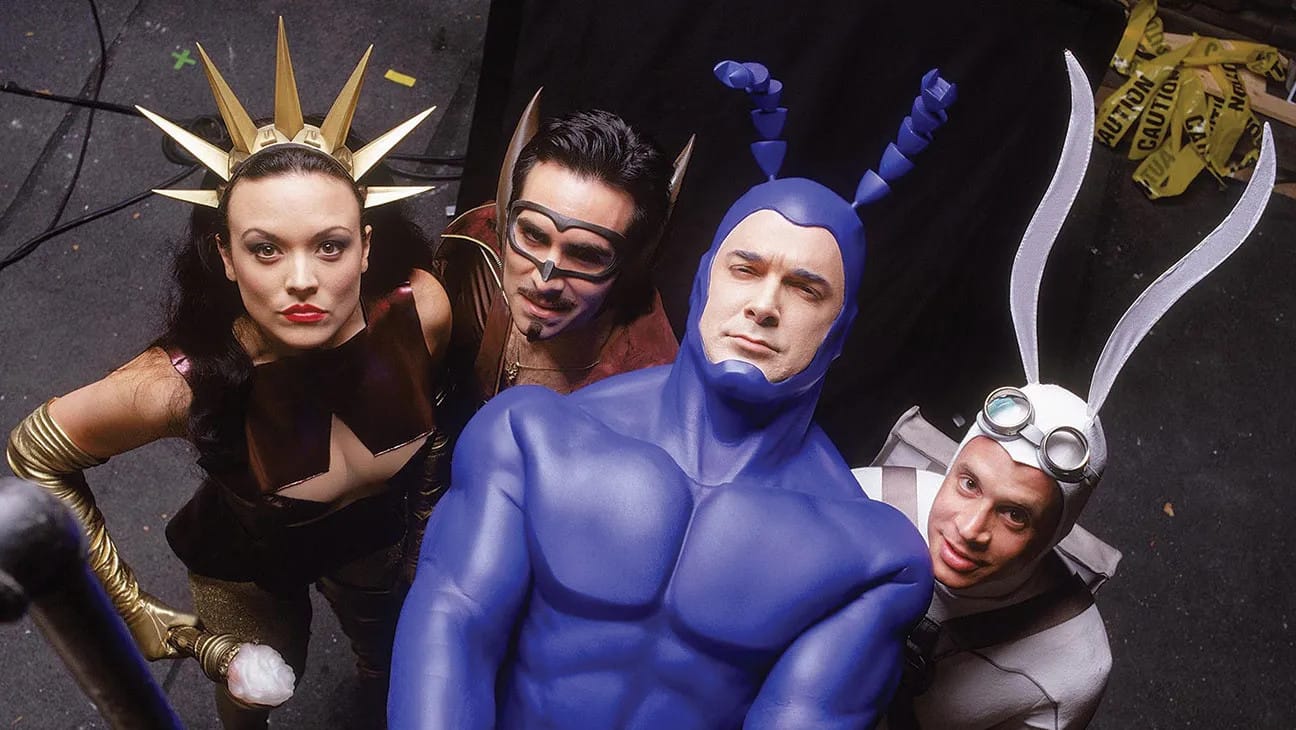
I did not care for the 2001 live-action incarnation of. The Tick. I did not watch it at the time and, like many things that happened in the early 2000s, it is not a pleasant experience looking back; just ask Stormy Daniels. TV was in that awkward transition from analogue film to early digital video, or to digital workflows, and much of it was produced, edited, and stored in low-resolution formats, with all the brash lighting and dynamic-range crushing that came with it. Worse still, early-2000s TV executives were really not sure how to connect with the emerging young adult market, seemingly aiming for a nightmarish middle ground somewhere between the Adam West-era Batman and Joel Schumacher’s Batman & Robin. The tone was more awkward than funny, and lacked the energetic absurdity of the animated show. Episodes felt slow and dialogue-heavy, echoing executive producer Barry Sonnenfeld’s inexplicable intention to push for a Seinfeld-like observational sitcom rather than a traditional action-comedy. Sonnenfeld later went on to make a live-action SpongeBob SquarePants inspired by The Wire and a surprisingly successful Band of Brothers inspired reboot of Dora the Explorer.
As much as Warburton was commendably throwing himself into the role, this version of The Tick came across as dumb and out of place in his own show.
“To get to step into the shoes of the Tick, I just felt that was an honour. Once again, I will reiterate that Fox apparently didn’t have a clue.”
— Patrick Warburton
Even guest appearances from Christopher Lloyd, Ron Perlman, and Penn & Teller could not save it, and the show was cancelled at the end of its first season.
Unable to appeal to kids as an animated show, and unable to connect with young adults and (old) adults as a live-action show, it seemed like all was over for the tiny Tick on the small screen. And so it was for 15 years until…
The Big Blue
By 2016 the world had become united and signed the global Schumacher accords, in which every human on the planet collectively agreed that Schumacher’s Batman & Robin never happened. The human race could now move on and comic-book heroes could, and indeed did, become solidly part of mainstream culture. The Avengers, Guardians of the Galaxy, and Spider-Man had momentarily convinced the world that a Marvel Cinematic Universe was something it wanted; and even DC had made some films that were not entirely terrible, as well as quite a few that were. Comic franchises were big money, and we had seen successful meta-humour and parody in the form of Deadpool. Had we finally reached the perfect moment, was the world finally ready to meet the wildest of blue yonders that was The Tick.
Ben Edlund certainly thought so. He developed a new, more grounded, version of The Tick and this time it was picked up by Amazon as part of the aforementioned, and cowardly, “Pilot Season”. But to reboot the show, a new lead was needed. Some have said they considered having Warburton reprise the role; however, I could not confirm that anywhere, and I suspect it was not a strong consideration. As great as he was, they likely wanted to avoid any association with the failed 2001 show.
And so once again when an American show really needs to find the perfect lead—someone who can deliver the kind of performance that will add weight and gravitas to what might become a new American icon—they turn, inevitably, to a British comedian, in this case Peter Serafinowicz. Not only did Serafinowicz have the physicality and deep vocal presence, but he was also able to find the line between the unhinged mental state, deadpan delivery, and unconstrained optimism of The Tick, and to play the absurdity completely straight without becoming sinister or clichéd in the parody.
In the wake of all that went before, the reboot was a confident reinterpretation. It walked about, metaphorical and actually, in its big blue costume in broad daylight; and was self-aware enough to make fun of the three major revisions to the suit design that happened between the pilot and series one, and then again in series two. Despite no longer wishing it was Seinfeld, the new show was much better at leaning into character and character dynamics.
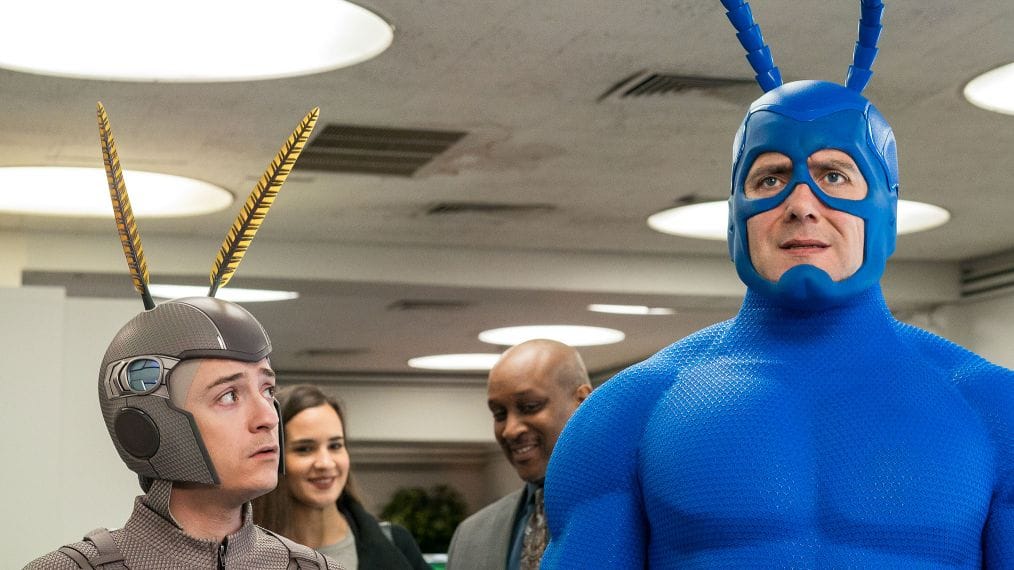
With improved writing and a more grounded performance from Serafinowicz, they were able to deliver a larger-than-life character who feels present in the show without being overbearing. Griffin Newman, as moth-man Arthur, ironically provides a grounded counterpoint that anchors the show emotionally without being dull. The expanded role for Arthur’s sister, Dot Everest, played by Valorie Curry, felt genuine and unforced. She works well with the over-the-top Overkill, played by Scott Speiser, and Speiser commendably plays a deliberately two-dimensional character with more depth than one might expect.
Yara Martinez and Jackie Earle Haley were also note worthy as the shows villainous antagonists. Martinez brought controlled intensity to Ms. Lint, giving the character a sense of emotional restraint beneath her volatility, while Haley’s portrayal of The Terror balanced absurdity with genuine threat, grounding the show’s satire in something more unsettling, delightfully evil and entertaining.
The result is a version of The Tick that feels more mature, less frantic, but more interesting without losing the bombastic nature of its lead. Structurally, the show also benefits from a longer running time and a clearer direction than the 2001 adaptation, presenting a cohesive world that takes its own internal logic seriously.
By season two plotlines did start meander, and the pacing becomes a little more uneven. There are still a lot of great moments, and it genuinely feels as though the writing was finding its voice. Sadly, time to develop is a luxury few shows are afforded, and The Tick is no exception. Once again The Tick was cancelled, this time at the end of its second season.
Unlike previous incarnations, where one could argue that the audience was not right, or that the tone of the show was simply off, this version felt as though it really got most things right. It was the right moment in history, it had a great cast, and by season two it finally had a suit that looked decent on screen. I would have loved to see how the show could have developed if it had been given a little more time. A lesser writer would say that the cancellation left me somewhat ticked off; but luckily, I am above such immature wordplay.
In conclusion
In the end, The Tick remains a curious, resilient oddity—forever slightly out of step with the moment it seems to find itself in, yet never entirely out of place. Each incarnation has inched closer to capturing the peculiar alchemy that makes the character work: a blend of absurdity, sincerity, and just enough self-awareness to stop it collapsing under its own ridiculousness. That the 2016 series came closest—and still did not survive—feels less like failure and more like the continuation of the character’s strangely fitting fate. The Tick is a meta-textual being; living in the margins of the newsletter that is mainstream superhero media. He endures not because he dominates the cultural landscape, but because, every so often, he bursts back into it—loud, blue, and gloriously optimistic. In an age where being optimistic looks increasingly like a superpower, I do not think it will be long before we have reason to call upon The Tick once again.